Welcome to Credit Carder.
  • Home
  • Bad Credit Car Loans
  • Credit Card Debt
  • Eliminate debt
  • Repaying debt
  • Consolidate
  • Blog
  • Privacy Policy
  • Terms & Conditions
  • Contact us

Ten Surefire Steps to get Errors off Your Credit Reports

7/17/2014

0 Comments

 
If you've already spent the past several months -- or even years -- trying to scrub errors from your credit reports, it may feel like you have no choice but to live with the inaccurate marks.

Don't give up. There are ways you can beat the frustration-causing standard credit report dispute process, say experts.

"The Fair Credit Reporting Act requires that the credit reporting agencies, such as Experian and Equifax and TransUnion, conduct a reasonable investigation whenever a consumer disputes information on their credit report," says Chi Chi Wu, a staff lawyer at the National Consumer Law Center in Boston.

The problem is, they rarely do, she says. Instead, credit reporting agencies often rely on the lenders, debt collectors and other data providers that furnished the misinformation to investigate a dispute. If the furnisher of the information mistakenly verifies the errors as correct, then those inaccurate marks will remain stuck in your credit file, no matter how many times you dispute them.  

"Because the bureaus spend so little time on investigating errors and usually take the word of the furnisher over the consumer, consumers often need to dispute multiple times, spend countless hours trying to fix mistakes and eventually often have to get legal counsel to get the problems fixed," says DeVonna Joy, an attorney at the Consumer Justice Law Center in Big Bend, Wis.

But before you threaten legal action, here are 10 steps you can take to make sure you submit a dispute that has the best possible chance of getting an error erased. 

1. Request a fresh report directly from the credit bureaus.
Before you do anything else, order a fresh report from the credit reporting agency, -- or agencies -- that are reporting the inaccurate information. You'll need this report to send in your next dispute and to keep on hand in case you later need to sue.

Order your report directly from the bureaus, not from a third-party reseller, and avoid relying on a report you got from a lender.

"If you get a report from a lender or another business, it may be a merged report," explains Rod Griffin, director of education at the credit reporting agency Experian. Ordering your report from the credit bureau "ensures that we are looking at exactly the same information that you are," says Griffin.

Ordering your most recent report also helps to make sure that the information you're disputing is up to date, he says. "If you're looking at a credit report that's several months old and asking about it, we may be looking at a completely different account. It's been updated or changed or something's happened," says Griffin.

Under the Fair Credit Reporting Act, you are entitled to a free copy of each of your reports at least once every 12 months. You may also get a free report if you've been turned down for credit within the last 60 days. You can order a fresh report online at AnnualCreditReport.com, by telephone at 877-322-8228 or by mail. If you've already used up your free report for the year or have a report that's several months old, go ahead and pay to get a new one, say experts. You can expect to pay up to $12, depending on the credit bureau and the state where you live. Some states, such as Colorado, California, Georgia and Maine, allow you to get an additional report for free or at a reduced price.  

2. Pore over the report for errors large and small.
When you last checked your report and saw there was an error, you may have only noticed major errors, such as a court judgment that doesn't belong to you or a debt that you're sure you repaid. However, look closely for other, smaller mistakes on your report, such as incorrect addresses or a slight misspelling of your name, say experts.

"Those kinds of things can be indicative of mixed files [or] of identity theft," says Joy.

Small mistakes in your identifying information could also cause bad information to get into the reports that lenders pull, which may include more information than what you see on your personal report, says Austin, Texas, consumer lawyer Amy Kleinpeter. "When a consumer asks for a credit report, [the credit bureaus] pull the information from an algorithm," she says, and the matching requirements are fairly stringent.

"But when the car dealer or the lender goes [and asks for a report], they use different algorithms that are wider and pull more information," says Kleinpeter.

As soon as you get your latest report, Joy recommends that you carefully scan it for variations of your name that you don't normally use, unfamiliar addresses, incorrect Social Security numbers or a wrong date of birth.

Also look at the section of your report that lists who has pulled your credit information, she says. If you see a company that you don't recognize or that you did not apply for credit from, ask the credit bureau why it gave them your information. It could be another sign that our file has been mixed up with someone else's credit.

3. Mark up the credit report, highlighting the mistakes.
"Photocopy the front page and photocopy the page with an error," says Kleinpeter. Then circle or highlight any error that you see, even if the error seems minor.

If there are multiple errors on your report, put a number next to each error, Kleinpeter adds. That will help you refer to the errors when you write your dispute. 

Once you've marked up the report, make multiple copies. You'll need them for your files, as well for your disputes.

4. Write or type your dispute letter yourself. Don't dispute the error online.
Sending in a dispute online may be quick. However, consumer lawyers say it's one of the biggest mistakes you can make.

"The online dispute is all about the expediency of the credit bureau," says Cary Flitter, a consumer lawyer and law professor in Philadelphia. Most online dispute forms give you just enough room to state your dispute, he says, but don't give you enough room to back it up. "They want you to just say, 'not mine' or 'bill was paid,' and that doesn't always tell the whole story," says Flitter. 

You also want to make sure you can fully explain any part of your case that's complicated or confusing, says DeVonna Joy. "The forms are set up to pigeonhole disputes into certain categories that may not exactly apply," she says.

Online disputes are also not set up to accept additional evidence, such as a copy of a check or of your Social Security card, say experts -- and those pieces of evidence can be important later on if you do need to go to court to prove that a credit reporting agency isn't correcting a legitimate mistake.

In addition, many online dispute forms contain arbitration clauses, which can undercut your consumer rights. "The credit bureaus bury waiver clauses in the click agreement," says Flitter. "By clicking, 'I accept," you're giving up the right to sue them if they do something wrong."

Type up, then mail your dispute instead. That way, you can include as much information and evidence as you need to explain your case. Also, if you do wind up in court, you'll be able to prove to the judge assigned to your case that you gave the credit bureaus enough information to properly investigate your dispute. 

5. Separate disputes into multiple letters.
If you have more than one error on your report, don't try to dispute all the errors together, says Flitter. Instead, write a dispute letter for each error and mail them separately. "The likelihood of getting something fixed is a lot better if you just do one at a time," he says. 

You'll also want to write separate letters to each credit bureau that's reporting the mistakes, says Joy. You do not want to send one big dispute to all three bureaus to save time." The credit bureaus aren't obligated to notify each other of the dispute until at least one of them has confirmed the error is inaccurate.

Keep a separate file for each bureau as well, she adds, so you don't lose track of what you sent to which agency. "The devil is in the details in these cases in terms of straightening things out," she adds, so it's important to keep it organized in case you need it later.  

6. Keep it simple.
The most effective dispute letters are often the easiest to read, say experts. Don't try to cite legal arguments or use fancy words, says Kleinpeter -- and avoid using form letters you found online.

"A lot of the letters that people put online as samples don't make any sense," she says. People throw in a lot of legalese and fake legal words, which makes reading the letters a chore, says Kleinpeter. "I've had a lot of well-meaning clients, intelligent people use those letters," she says.  "And they got nowhere."

Instead, write a brief, pointed dispute letter that politely explains in plain language what the error is and why the information does not belong to you.

"You need to be very clear" about what you're disputing, says Experian's Rod Griffin. "'The account was never mine.' 'The payment was never late.'"

But you also want to make sure that you include enough information to back up your claim, says Flitter. Otherwise, the credit bureaus could later argue that you didn't give them enough information, he says.

Finally, write the letter yourself, says DeVonna Joy. "The dispute must come directly from the consumer to trigger credit bureau obligations to investigate," she explains.  

7. Include evidence.
Attach whatever evidence you can find, backing up your dispute.

"Include every bit of documentation and every bit of detail available to you," says Leonard Bennett, a consumer lawyer in Newport News, Va. That way, the credit bureau can't say that you didn't give them enough information.

"The big three [credit bureaus] consistently lose or claim to lose consumer correspondence," he adds, so make copies of all your correspondence, including every piece of evidence that you mail.    

8. Mail your dispute to the credit bureaus -- and to the data furnisher.
If you know which lender, collection agency or other type of data furnisher (the ones giving out your information) is misreporting your credit history, send them the same information that you sent the credit bureau, say experts.

"Doing so at the same time may help resolve those issues more quickly," explains Experian's Rod Griffin.   

It also ensures that data furnishers have enough information to investigate your dispute. "That's another reason to do paper disputes because you're going to be caught in the middle," says Flitter. The credit bureaus process your dispute by assigning a category code to the dispute and sending a short summary to the furnisher to investigate the problem. The credit bureaus rarely include the documents you mailed with your dispute and so the furnisher only gets the bare minimum of information, he says.

"Many court cases on this turn on the extent of the information that the credit bureau gives the furnisher," says Flitter. "The credit bureau will say, 'customer claims paid,' but they will never attach a copy of the check. They're just not geared up to do that."

It's also a good idea to send all your correspondence by certified mail, say experts. That way, "If they come back and say, 'Well, we didn't get it,' you've got a little green card that the post office sends back to you showing that they signed for it," says Markus Horner of Sachse, Texas, who spent years contesting errors on his reports. Horner also recommends that you write the certified mail number on each letter so that you can easily match the certified card with the original dispute. 

9. Stay organized.
"Obtain and keep very careful records. Of everything," says the Consumer Justice Law Center's DeVonna Joy. "Who you talk to if you call, when, what is said, all written communications, all credit reports, all denials for credit ... Throw nothing out," she says.

You never know when you'll need to use them later on. "Once someone is mixed with someone else, either through theft of identity or a credit bureau error, they are potentially always mixed," says Joy.

LoriAnn Peccoro of Paramus, N.J., also recommends creating a "credit binder" to store each transaction and dispute. "I look at this binder like it's my birth certificate," says Peccoro, who spent nearly a year fighting errors on her report. "If you've got it in black and white, you've got it," she adds.

10. Don't accept no for an answer.
If you've disputed an error several times and it continues to be verified by the credit bureaus, consult a lawyer experienced in Fair Credit Reporting Act cases. "The best place to find one is at the website of the National Association of Consumer Advocates," says Joy. "Click on 'Find an attorney' and check the profiles of the attorneys in your state to see if they handle FCRA cases."

Finally, don't lose patience, says Rahul Sharma of College Station, Texas, who spent six years trying to get multiple errors off his reports. "When you look online, people advise that you can't do anything; there is no hope," says Sharma. However, if you keep pushing for it, you'll eventually get the errors off your reports, he says. "Just don't give up," Sharma adds.


0 Comments

Payday Loans and Other options 

7/16/2014

0 Comments

 
**Today’s guest post is contributed by Christian.**

If you want to maintain a healthy credit history, stay away from payday loans.
A recent Consumer Financial Protection Bureau report shed light on how damaging these pay-advance options can be. Check out the study yourself to get the full picture. You’ll likely notice how the fees can quickly add up since the fee is calculated as a fixed dollar amount per $100 borrowed.

Or maybe you’ll see that the median amount borrowed was $350. Perhaps the fact that 14 percent of borrowers had more than 20 payday loan transactions in a 12-month period stands out to you. But the most impactful statistic highlights how toxic payday loans can be.

Two-thirds of consumers in the report took out at least seven payday loans in a year. These consumers often opened a new loan within a day of closing one, but most often opened a new loan within 14 days of closing one. Payday loans basically become a constant source of cash in place of paychecks.

So how do you avoid the payday loan trap when you need money in advance? Take a look at these options.

Credit Cards

Being smart with a credit card is a great financial move. As long you’re paying the balance of in full every month, credit cards are much safer than payday loans. Swipe a card and pay it off as soon as you get your paycheck. You may even be able to take out a cash advance on a credit card. The interest rate will still be high, but even if it’s 40 percent, it’ll cost far less than 300 to 500 APR on a payday loan.

Small Loans

Credit unions and small banks can offer loans in small amounts with better interest rates and repayment terms than a payday loan. It’s best to find one with a repayment period of no less than 90 days that can be repaid in installments. This way you’re not constantly paying fees like a payday loan borrower does every two weeks.

Paycheck Advance from Employers

If you’re fortunate enough to have a benevolent employer, you could get a paycheck advance. It’s the same concept as a payday loan, but there’s no interest and it’s your money so you won’t fall into debt.

Borrow Money from Friends or Family

For consumers who don’t need much money in advance, ask friends or family for some help. Chances are they won’t ask for an interest rate, but don’t burn bridges by never repaying them.

Use Your Emergency Fund

There’s a reason personal finance blogs advocate building an emergency fund. When an unexpected expense pops up, you’ll be ready to use these dedicated savings.

Live Within or Below Your Means

No matter what, this is a good mantra to live by all the time. Spend money within your means and you won’t even need credit cards or cash advances of any kind. Evaluate your needs versus your wants and cut expenses from the latter.


0 Comments

How Does a Short Sale or a Foreclosure Impact Your Credit Score

7/15/2014

0 Comments

 
Picture
You are most likely weighing the pros and cons of a short sale vs. a foreclosure. If you, like many other Americans right now, are coping with a challenge to meet your mortgage payment. This may be due to one or a combination of these common struggles: 1) job loss, 2) increasing rates if you are in an ARM loan, and 3) decreasing home values. It is most likely that you are deeply concerned with how either of these ugly terms will affect your credit score and which one may be the better choice of the two burdens. Instead of being intimidated, you are at least getting educated on your choices and the consequences. Though the reality of a short sale or foreclosure is not positive, researching what you will face is a good start to finding the best solution to your individual situation.

With a short sale, lenders typically take a loss on a loan that reflects the difference between what you owe and what the property actually sells for. They must be willing to accept this level of risk, and may execute one of two actions in a short sale: A) Sue you, the homeowner, for the difference; reflecting on your credit as a deficiency judgment which could profoundly impact your credit score in a negative way, or B) if they choose not to sue, they very well could absorb the loss, show it as a tax write off, and the IRS would see this as income sent your way. You would then be taxed based on the difference of the lender’s loss. This could prove to be extremely costly; however there would be no deficiency judgment showing on your credit.

Maybe your mortgage payments are current and you could proactively foresee any issues with your ability to continue to make them. Partnered with being current, if you have available assets to pay the difference within your short sale, then there should be no need for negative dings to your credit. Since you are in control of the sale, on top of your mortgage payments, and could pay the difference out of pocket, this may not be handled as an actual foreclosure. Hence this would be the ideal situation.

Now, a foreclosure is exactly what it is. You have fallen behind in your mortgage payments; you cannot sell your home due to housing market conditions and have chosen to walk away. A completed foreclosure can stay on your credit for up to 10 years and can literally sink your credit scores. Your credit score could potentially drop anywhere from 100 to 400 points; severely impairing your credit. If you are forced into a short sale, behind on your payments, and are unable to pay the difference, this “short sale” could reflect on your credit just the same as a foreclosure would.

Either situation that confronts you, whether it is after your foreclosure or a deficiency judgment from a short sale, the key to recovering from this successfully, is the determination to improve your credit once the damage is done. With your positive actions, commitment and patience you can fix your credit, and the dream of becoming a homeowner once again could someday become a reality.


Lexington Law General Logo
0 Comments

How To Handle Charge Offs

7/14/2014

0 Comments

 
Charge offs can take their toll on your credit report. The long-term effects of unpaid bills on your credit reports can last for up to seven years. While it may be tempting to ignore past transgressions, there are proactive ways to approach the dark spots on your credit report. Follow the steps below to properly handle a charge off and minimize the damage.
Picture
1. Review: Before dealing with the charge off citation itself, begin by ordering copies of your credit reports from the three major bureaus: Experian, TransUnion, and Equifax. Next, locate the name of the creditor who reported the charge off. (Note that the citation may appear on all three reports.)


2. ValidateIt is important to make sure that the charge off listed on your credit report is in fact, yours. Draft a letter to creditors and their third-party collection agencies asking for debt validation in the form of written account statements from your original creditor, outlining:

  • The amount you currently owe
  • A complete payment history
  • Additional calculations such as fees, interest, and penalties
  • A copy of the original agreement or application between yourself and your creditor
  • Documentation that the debt is in fact now owned by any third-party collection agency also reporting the item to the credit bureaus
  • Documentation that any third-party collection agency is bonded to collect in your state of residence
  • Documentation that any collection fees were added pursuant to the original lending agreement
3. StrategizeIf the credit companies reporting the charge offs to the credit bureaus are able to validate your debt within 30 days, you will face a fork in the road. You have the option of:

  • Making a deal. The collection agency wants their money, and they may be willing to strike a bargain to get it. Draft a letter asking if they would be willing to delete the charge off citation in exchange for partial or full repayment. If they agree (in writing), send the collection agency a money order or certified check. Make copies of the agreement and the payment for the credit bureaus.
  • Waiting it out. A downside to repaying a charged off account is the risk of additional damage. Reactivating — or “re-aging” as the credit companies term it — an overdue account can cause your credit score to take another hit after the fact. Review your credit score and decide if you can afford to lose points. While charge offs remain on your credit report for up to seven years, weighing the pros and cons of repayment is an important aspect to consider.
Unfortunately, even when following the guidelines outlined here, you may sometimes encounter creditors that are disinterested in preserving your consumer protection rights. That’s where credit repair lawyers may be able to assist with how accounts appear on your credit report.

You can’t undo the past, but you can control how you handle the future. While there may be no clear and simple way to handle a charge off, utilizing the available options is key. Invest some time in cleaning up your credit—you’ll be glad you made the effort.


0 Comments

Your credit card is NOT your emergency fund

7/10/2014

0 Comments

 
Picture
There’s no need to look at the stats anymore: a lot of people in many countries can barely keep up with their debt, while many still have no ‘sign’ of an emergency fund. And, as you can imagine, when you’re more ‘uncovered’, bad things happen.

This makes some of them try to solve their emergency by getting into more debt or are keeping credit cards just for the sake of the rewards, swearing they’ll always be on time with the payments. Many of them won’t be able to, so this is when the INSANE interest kicks in and gets them even deeper into debt.

For someone who’s used to having all kinds of credit cards, living without them is something impossible to comprehend, even if there are still quite enough people who make ends meet, pay debt (if they have any) and save money without the need to ‘trust’ their future on a credit card.


PERSONAL SITUATION: We’re both debt free and are currently preparing for our child. We had to spend quite a lot to get ready (we chose to buy all the needed stuff step-by-step, by using all opportunities and sales), besides the regular expenses (from which the taxes and our small businesses expenses rank pretty high).

My husband’s side of the business is slowly picking up, so we’ve been living off one income – one income and a half for quite a while now. We’re also saving money for the birth (I’ll have to pay for it at a private clinic) and any other expenses. Each year we’re taking a 3 week vacation in Croatia (we’re already planning the next one for September), which again costs quite a biy.

Everything is covered with the money we earn from our businesses and, when needed, the savings. We both have debit cards, tied to our accounts with zero overdraft. We have never used credit cards and probably will never do so.

Husband is against any type of credit, while I had my share of misery with owing money, so no, thank you. While many struggle to understand how we can sleep at night, knowing that anything could happen and we have ONLY the money we earn/saved, we’re sleeping well at night, not having to worry about interest and other ‘goodies’.

Stuff happens, so be preparedI will NEVER advise anyone to think that life is all roses and unicorns, since it isn’t. Just when you think everything is running smoothly, life will kick you in the nuts and you’ll have to deal with the outcome. This is why I do think an emergency fund is VITAL and that, any money you can save, will clearly be useful one day in the future. It doesn’t matter where you keep your saved money: in a jar, in envelopes, in an account that’s easy to get to, whatever works for you. But DO SAVE money each month if possible, believe me one day it will be put to good use.

As long as you have stashed some money aside, you don’t need to rely on any lines of credit, because you already have something to rely on. I don’t care about interest, I don’t care to invest that money, I don’t even care where I keep it. What I want from this emergency fund is to 1. have it (and slowly increase its value) and 2. get access FAST, if I need.

You do need to understand that not all the things are emergenciesWhen you have a credit card (and can take money easily), you’re probably more inclined to be too ‘loose’ with spending it. I know for instance that we’re not that fast with spending our savings for any crap, because we do know that we have NOTHING else and we need to be careful. Sure, there are friends who could lend us some money or even our parents, but we’re clearly trying to solve our own problems.

When your car breaks, it’s clearly an emergency. When you have some health issues that need to be addressed now, it’s an emergency. The fact Macy’s has a sale is not.

Learn to really make the distinction between something that needs taking care of NOW and something that you’d like to buy/pay for.

My husband would like to have his own car (his old one doesn’t work anymore) and he could surely use one. Right now he’s using mine (not such a huge deal since we work from home and he needs it to go to clients (while I can clearly schedule my ‘trips’ at any other time) and he’ll probably do so for the next 3-4 years.

Could he get one now? I think we have enough savings for this and there’s always a bank willing to loan you money. But we’re OK right now, we have other priorities for our savings at the moment.

Sure, when his gas analyzer had to be checked, an unexpected tax paid or the car insurance bought for the next 12 months, we immediately allocated the funds and solved all these problems.

Wants are not needsOne of the biggest things we can do for our financial security is to learn how to live a good fulfilling life and yet not go overboard with our spending. We both have chosen few priorities (things that really make us happy) and are willing to spend more for them, while being frugal when it comes to the ones that really have no impact on our happiness.

It’s clear that, unless you’re a millionaire, you can’t really afford everything, but you can clearly set few priorities that make your life beautiful and will be able to fund them, while not breaking the bank.

But those rewards would be so coolMany credit cards come with a lot of perks. If you’re VERY disciplined with your spending, know exactly how to ‘stretch’ your money and are always on time with the payments, you can clearly use some of the money you’ll earn or anything else that comes with the credit card.

The sad situation is that many of the people who use credit cards will eventually fall off the ‘I’ll pay in time’ wagon and then the interest rates absolutely smash them. When you’re paying over 25% (and more) just in interest, the 2% rewards are nothing, you’re bleeding money and quite seriously.

But what if your car breaks in the middle of nowhere?We’re both travelers and have gone in many places. We took airplanes or drove our car to the destination. We always have cash at hand (enough to pay for few nights at a hotel, for some car repairs and even fly back home). Not to mention we never drive cars that we don’t trust (when husband noticed his car is not up to par for a 2000 mile drive, he decided to use it only in the city, where any issues can be solved in minutes). My car is still like new (5 years old, but in perfect condition and well taken care of), we always do the maintenance in time, have a spare tire and at least half a tank of gas in a big canister.

My husband NEVER leaves for a trip unless he knows that we have enough gas to take us at least few hundred kilometers. We also carry our debit cards (with access to well ‘stocked’ accounts) and can get more money in under 24 hours anywhere in the world.

The main difference between us and someone who’s use a credit card for this situation is that, once we get to a bank, we rely on our own money and don’t need the credit. We still swipe a card and get money off it, of course, unless the cash we have doesn’t get us out of the trouble.

Many credit card holders consider them to be a way to get some quick cash, when they need it. Sure, ideally, the money would be paid back in time and they’ll be able to enjoy life as before.

In our case saving the money covers us too, but without the stress of having to replenish the account in a set time. We HATE it when something happens and we need to get into our savings (aside traveling or buying some things we already budgeted for anyway), but at least we don’t have to hurry with paying back any money and we can re-stock the savings at our own pace.

So, if you asked me, we wouldn’t be too pleased to have to rely on a credit card to pay for any emergencies. By spending money carefully and making sure we always save, most emergencies that come our way can either be solved by the ‘regular’ cash-flow that month (fortunately not all will require a lot of money) or by taking some money from the savings/emergency account. We don’t plan for that money to earn us interest, we don’t care for rewards or anything, what it needs to do is to solve our problems the moment we need it.

What about you and your emergency fund? Do you still use credit cards to pay for emergencies? Have you started saving money aside so that anything that comes your way won’t need credit card funding? What works better for you?

Your Credit Goals are Within Reach 728x90
0 Comments

How to pay off Credit Card Debt

7/9/2014

0 Comments

 
Click here to eKim writes in:My dad told me that the best way to pay off a credit card is to pay it all off at once so I have been saving up the money to do that. My boyfriend argues with that saying that the best way to do it is to make the biggest possible payment each month. Who is right?

Your boyfriend’s plan is better in a very straightforward sense. I think your dad is also bringing a good concept to the table, too.


If you look at nothing but the debt, the best way to pay off that debt with the minimum total interest payments for you is to pay it off with the largest payments you can throw at it each month. 


Let me give you an example. Let’s say you owe $1,000 and that it’s compounding at a rate of 2% per month (which would be roughly a 25% annual interest rate). Let’s also say that the minimum payment is $25 and that each month, you’re capable of putting $200 toward that debt each month.

Now, let’s follow your father’s plan.

After the first month, you’ve paid the $25 minimum payment and put $175 in the bank. The starting balance was $1,000 and 2% interest was charged – $20. Your $25 covers the $20 in interest and knocks $5 off of the balance, bringing the ending balance down to $995. Your bank account has $175 in it.

After the second month, you’ve paid the $25 minimum payment and put $175 more in the bank, raising your account balance to $350. The starting balance was $995 and 2% interest was charged – $19.90. Your $25 covers the $19.90 in interest and knocks $5.10 off of the balance, bringing the ending balance down to $989.90. Your bank account has $350 in it.

After the third month, you’ve paid the $25 minimum payment and put $175 more in the bank, raising your account balance to $525. The starting balance was $989.90 and 2% interest was charged – $19.80. Your $25 covers the $19.80 in interest and knocks $5.20 off of the balance, bringing the ending balance down to $984.70. Your bank account has $525 in it.

After the fourth month, you’ve paid the $25 minimum payment and put $175 more in the bank, raising your account balance to $700. The starting balance was $984.70 and 2% interest was charged – $19.69. Your $25 covers the $19.69 in interest and knocks $5.31 off of the balance, bringing the ending balance down to $979.39. Your bank account has $700 in it.

After the fifth month, you’ve paid the $25 minimum payment and put $175 more in the bank, raising your account balance to $875. The starting balance was $979.39 and 2% interest was charged – $19.59. Your $25 covers the $19.59 in interest and knocks $5.41 off of the balance, bringing the ending balance down to $973.98. Your bank account has $875 in it.

After the sixth month, your starting balance of $973.98 is charged 2% interest, equaling $19.48 and bringing your balance to $993.46. You apply that $875 saved to that balance along with an extra $118.54 to pay it off.

All told, under your father’s plan, you will have paid $1,118.54 to pay off the loan. Now, what about your boyfriend’s plan?

After the first month, you’ve paid $200 directly to the credit card company. The starting balance was $1,000 and 2% interest was charged – $20. Your $20 covers the $20 in interest and knocks $180 off of the balance, bringing the ending balance down to $820.

After the second month, you’ve paid $200 directly to the credit card company. The starting balance was $820 and 2% interest was charged – $16.40. Your $200 covers the $16.40 in interest and knocks $183.60 off of the balance, bringing the ending balance down to $636.40.

After the third month, you’ve paid $200 directly to the credit card company. The starting balance was $636.40 and 2% interest was charged – $12.73. Your $25 covers the $12.73 in interest and knocks $187.27 off of the balance, bringing the ending balance down to $449.13.

After the fourth month, you’ve paid $200 directly to the credit card company. The starting balance was $449.13 and 2% interest was charged – $8.98. Your $25 covers the $8.98 in interest and knocks $191.02 off of the balance, bringing the ending balance down to $258.11.

After the fifth month, you’ve paid $200 directly to the credit card company. The starting balance was $258.11 and 2% interest was charged – $5.16. Your $25 covers the $5.16 in interest and knocks $194.84 off of the balance, bringing the ending balance down to $63.27.

After the sixth month, your starting balance of $63.27 is charged 2% interest, equaling $1.27 and bringing your balance to $64.54. You pay it off in full.

All told, under your boyfriend’s plan, you will have paid $1,064.54 to pay off the loan. This is $54 less expensive than your father’s plan.

The principle is very clear: in terms of maximizing every dime in a perfect environment, you’re better off making big payments on the debt than holding cash back for a big payment at the end.

So, what benefit is there to your father’s plan, then? The benefit appears when you recognize that your life is not a perfect environment.

If you do not have any cash in the bank and something unexpected happens in your life, like the transmission in your car failing or your grandmother passing away, you’ll find yourself in a situation needing more cash than what you have and your response to that will be to add to your credit card balance.

Of course, you might just think that having a credit card with some of the balance paid off will serve your needs, as you can just use that credit card. The problem with that scenario is you’re trusting that the bank won’t lower your credit limit. That’s a tactic many banks use if they see someone who is a potential risk at their current credit limit. If they lower that limit, then you’re really in a bind.

Cash is the most secure emergency fund. You’re not relying on a bank extending credit to you for your emergency protection purposes.

Given that, is your father’s plan better than your boyfriend’s plan? It really depends on what the rest of your life looks like. Do you already have an emergency fund? If so, then your boyfriend’s plan is a better one. Do you have lots of avenues of risk in your life, such as a car that you need for a daily commute? If so, then your father’s plan is better because of the security it provides.

This is one of those situations where personal finance really is personal. If you assume a perfect life, your boyfriend’s repayment plan is best. The question is how perfect will your life be during the period of repaying that debt.

Clean Up Your Credit Report
0 Comments

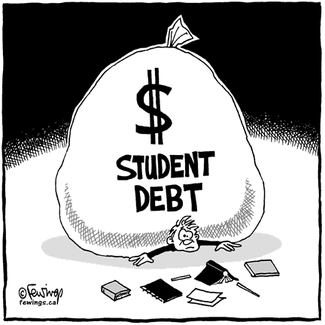
Student DEBT

7/8/2014

0 Comments

 
Picture
Credit card debt doesn’t shy away from anyone who doesn’t want to shy away from it. It treats everyone equally irrespective of whether the person is a seasoned professional or just a college student. So college student credit card debt isn’t uncommon either. Since the credit limit on college student credit cards is much lower, the college student credit card debt cannot rise to the levels it does for other credit cards. However, college student credit card debt is an even bigger menace because a lot of students are already in debt due to the loan they have taken for their education. If they pass out of college with college student credit card debt, they will have to payback not just the loan they taken for studies but also their college student credit card debt. 

Since most of the college students are inexperienced in the usage of credit cards, they can easily fall prey to what we call as ‘college student credit card debt’. In fact, college student credit card debt is one reason why the credit card suppliers keep a lower credit limit on college student credit cards. The solution for avoiding college student credit card debt is similar to what it is for avoidance of any type of credit card debt. So, the first thing for avoiding college student credit card debt is to understand the concept that credit card is not free money and that whatever you pay-for using your credit card has to be paid back to the credit card supplier when your credit card bill arrives. So don’t treat credit card separate from hard cash. Avoid overspending e.g. do not buy things just because they are on sale, sales keep coming and going and there are always better offers each time; buy only those things that you really need. A good thing to do is to prepare your monthly budget and follow it religiously. Never budge from your budget. Another very important preventive measure for avoiding college student credit card debt is to avoid going for a second credit card. Some students have a tendency to go for multiple credit cards just because the credit limit on college student credit cards is very low. However, this is a perfect recipe for getting into a college student credit card debt. This is how college student credit card debt builds up. One credit card is more than enough for any student. College student credit card is really meant to be treated like a training ground for learning more about credit cards. It should not be make an instrument of debt (college student credit card debt).
0 Comments

How to Remove Bad Credit from My Credit Report?

7/7/2014

0 Comments

 
Your credit report is not a matter of destiny carved in stone. It is a complete myth that once you have bad credit you will always have bad credit and all the attendant consequence — high interest rates and no chance of getting a loan for anything ever again. It’s also a common misconception that seven to ten years must pass before a negative item disappears from your credit report. You can take control of your credit reputation once you understand how to remove bad credit from credit reports — and it just takes a matter of weeks. There’s nothing difficult about the process; so prepare to get proactive with your own financial status.

First, understand that by law in the United States you are entitled to one free copy of your credit report per year per credit bureau (Equifax, Experian, TransUnion.) The fastest way to get started is just to go over to AnnualCreditReport.com. When you are turned down for credit:

  • get copies of your credit report.
  • have the company that turned you down tell you why specifically.
  • get to work on your own.
Go over everything on your reports and find the “bad” items. Steel yourself. It’s time to get in there and dispute the problems. This is not a process for the bashful or the faint of heart. You have to stand up for yourself to get bad items removed from your report. That means calling the bureau, talking to someone about your report, and negotiating. It also means taking the initiative to round up any necessary paper work to validate your claims.

Understand from the beginning that there are things the credit bureaus don’t share with you that put a great deal of power in your hands, including:

  • The credit bureau has to be able to prove every item on your report or the item must be removed. If they can’t verify the item, they must expunge it. Essentially what happens is that the bureau gets in touch with the source reporting the bad item. If they don’t get confirmation back in 14 days, they have to remove the information from your credit report.
  • Computer operator mistakes can and do happen. Something as simple as a loan that has been paid showing up on the report as outstanding can effect your credit. If it doesn’t look right to you, pursue the matter vigorously. Give the company the exact nature of the error and tell them how it should be listed. Back up your position with faxed photocopies. For instance. “Loan 334455 was paid in full on 11/11/08. See attached photocopies for confirmation.” (Keep copies of all your correspondence with the credit bureau.)
  • Never forget that time is on your side. Often a “bad” item that is a year or two old can’t be verified because the records just aren’t there any more. Entities go out of business, move, or discard records rather than pay for the expense of storing them. The moral of this story is, go after the old stuff first. Even if the business is still in operation, they may not want to dig back through old records to verify the item in question. Remember, all you need is two weeks with no response and the item is gone.
The truth is that many people suffer from bad credit because they’ve never reviewed their credit report, cleaned up the errors, or disputed old items that are likely to be easily removed. Whether for lack of information or lack of energy, the most common stance people take is to simply accept their credit report without question. That’s a costly strategy and one that puts an unnecessary burden on millions of consumers every year. In 90 percent of cases, you may need a lawyer or the assistance of a professional credit repair agency to remove bad credit from your report, unless if you have some personal initiative.


Legally repair your bad credit today.
0 Comments

Restore, repair, fix or re-establish credit after Bankruptcy

7/4/2014

0 Comments

 
Picture
Personal bankruptcies filings will set an all time record this year, up over 28%. There just is not enough information on how to restore, repair or fix your credit after bankruptcy.

Are you wondering what the effects of Bankruptcy on your credit are? Are you concerned if you will ever get credit after the Bankruptcy is complete? We find most consumers don’t really understand the Bankruptcy process first of all, and have no idea how it will affect their credit rating and credit score.

Filing bankruptcy is the first step towards the restructuring and rehabilitation of a credit file. What most consumers don’t understand is that filing a bankruptcy is just the beginning.

Bankruptcy does not resolve negative credit history. Bankruptcy only absolves debt.

Derogatory and harmful marks on the credit report are results of all chapters of bankruptcy filing. There is no quick fix! The events leading up to bankruptcy more than likely included late payment history, charged off accounts, slow pay or no pay. With a clear accounting of events begins the restoration and repair of the credit report.

Left alone, these negative items remain for 7 to 10 years until the statute on limitations expires. Even after that, unscrupulous bill collectors and creditors may unlawfully continue to report the derogatory items! The good news is that it’s possible to recover from the negative credit effects of Bankruptcy much sooner.

Creditcarder.org has a program designed to begin the process of rebuilding and restoring credit through resolution and elimination of derogatory credit history. This program can legally eliminate derogatory credit file information placed both before and after bankruptcy. This program will re-list the account information on the credit file eliminating much, if not all, of the derogatory credit information history. This program can be utilized whether you used an attorney for the filing, or filed without an attorney or a paralegal.

Only after a detailed and complete verification process is followed, any inaccuracies and unverifiable information removed, can one finally re-establish credit after bankruptcy.

Establishing credit after bankruptcy is not an impossible process, just a difficult one. Our counselors can advise you in the critical steps in the re-establishment process, including where to find credit cards, loans and financing that are accepting of your bankruptcy and offer the best rates.

Of course, we do want to emphasize the importance of credit remediation first. Either that, or wait the 10 years.

Talk to a Bankruptcy Credit Specialist for more information, CALL TODAY 866 945 0102.


2010 Bankruptcy Deletions by Company
0 Comments

How to Ruin Your Credit Health

7/3/2014

0 Comments

 
There is always that one scene in horror films. Instead of running for help, the hero runs into the dark basement or the eerie forest. You yell at the screen, wondering how this character can be making all the wrong choices. But, imagine the scenario a little differently. What if instead of running for your life, you were navigating your credit health? Are you making all of the best decisions, or are you at risk of ending up in the dark basement with a scary credit score? Here are four pitfalls to avoid as you escape towards happily ever after.


Picture
1. Keeping up with the JonesesWhen I was in college, I drove a 1997 Nissan Maxima. The car was patched up with random car parts over the years. These cheap replacement parts came in so many colors that I named the car Two-Face. Two-Face sometimes embarrassed me when I saw other people driving sleek, new cars, but it was worth it for all the money I saved.

It can be difficult to ignore your friends' new purchases. However, unless you've been saving up or have extra funds lying around, it is probably in your best interest to say no to material gratification. The temptation is strong since it's so easy to charge everything to credit cards, but it's a lot harder to dig yourself out of debt. And when you can't pay back your debt, your credit will suffer.

2. Co-signing for someone with bad creditWhile helping a close friend or relative can be rewarding, you also need to look out for your own credit health. If this friend needs you to co-sign because they haven't established their own credit yet, and if you trust them, your credit shouldn't be affected negatively. However, if you suspect this person might not make payments on time, or if they already have bad credit due to poor decision making, you might not want to co-sign after all. Keep in mind that when you co-sign for someone else, you are basically taking on their loan as your own. Therefore, if they stop making payments, your wallet and credit health will suffer the consequences.

3. Not paying your library fines or parking ticketsWhen I was a kid, I had the bad habit of forgetting to return my library books. Back then, it was easy to smile toothlessly and feign innocence, so the librarians would waive my fees. As an adult, though, fines that aren't paid can end up at a collection agency, and smiling at the credit bureaus won't remove those marks from your credit report. Just as with unpaid library fines, unpaid parking tickets can also be turned over to collection agencies. Even after you have paid off the collections, these accounts can remain on your credit report for seven years, and creditors will see these red flags on your report. Even so, it is still usually better to fully pay collection accounts sooner than later. You wouldn't want the Twilight series or a street sweeping ticket to be the reason why you're not accepted for a new home loan.

4. Not communicating with your landlordEveryone has heard a story or two about a bad landlord. It's reassuring to think that the bad situation ends as soon as the rental contract does. Unfortunately, landlords can wreak havoc on your credit even after you've moved away. If they decide the place was left in an inappropriate condition, they can charge you for repairs and cleaning costs. Your security deposit can be used for these charges, but if the deposit doesn't satisfy the costs, they can send the bill to a collection agency. The best way to avoid seeing a surprising bill is by taking precautions. Save important documents, take pictures of the home before you move in and communicate with the landlord to ensure a pleasant ending to your stay.

In the end, it's worth it to stay proactive while protecting your credit health. Check your credit report regularly and make smart, thoughtful decision to stay in the best position possible. When it's all said and done, you don't want to look back at your younger self and feel like you're in the back of a movie theater, yelling in vain.

Author: 
Nazhat Salim
Lexington Law General Logo
0 Comments
<<Previous

    Archives

    January 2023
    December 2018
    September 2018
    August 2018
    July 2018
    April 2018
    March 2018
    September 2017
    August 2017
    January 2017
    December 2016
    November 2016
    November 2014
    July 2014
    June 2014
    January 2014
    October 2013
    August 2013
    April 2012

    Categories

    All
    A Credit Card
    A Credit Card
    #badcredit
    #badcredit
    Bad Credit
    Bad Credit
    Card Credit
    Card Credit
    College Student
    College Student
    College Student Credit Card
    College Student Credit Card
    Credit
    Credit Card
    Credit Card
    Find Me A Credit Card
    Find Me A Credit Card
    For Which Credit Card
    For Which Credit Card
    Help Me Find A Credit Card
    Help Me Find A Credit Card
    How Can I Get A Credit Card
    How Can I Get A Credit Card
    How Do I Get A Credit Card
    How Do I Get A Credit Card
    How Do You Get A Credit Card
    How Do You Get A Credit Card
    What Is A Credit Card
    What Is A Credit Card

    RSS Feed

Powered by Create your own unique website with customizable templates.
Photo used under Creative Commons from Got Credit