Welcome to Credit Carder.
  • Home
  • Bad Credit Car Loans
  • Credit Card Debt
  • Eliminate debt
  • Repaying debt
  • Consolidate
  • Blog
  • Privacy Policy
  • Terms & Conditions
  • Contact us

Paying Interest vs. Earning Interest

6/30/2014

0 Comments

 
This guest post was written by Miranda Marquit. Miranda is a freelance writer and professional blogger. Her blog is Planting Money Seeds.

When we think about interest, many of us immediately think about paying it. High interest credit cards come to mind, and we dismiss interest as a bad thing.

It’s true that paying interest can be a problem. After all, you're giving money to someone else, and interest adds to your debt if you carry a balance. On the other hand, interest can be a good thing – if you’re earning it.

Paying Interest: A Drain on Wealth

Credit cards can be a valuable financial tool. Savvy credit card use improves your credit score and can lead to lower interest rates on major loans, particularly home loans and car loans. This can save you money over time on the large purchases that almost always require you to pay interest.

While paying interest on your home loan or auto loan can be disappointing and costly, the interest rates are generally fairly low, especially if you have good credit. The interest rates that will really get you are those charged on credit cards. When you pay a high rate of interest because you are carrying a balance from month to month, you can easily fritter away a great deal of wealth.

You can look on your credit card billing statement to see how much interest is added to your credit card balance each month. If you have a high balance on multiple credit cards, you could be paying as much as $200 (or more) a month in interest.

That’s money that doesn’t buy you anything new, or provide any other benefit. Your interest payment is money that goes straight into someone else’s pocket. What could you be doing with that money instead? How could you be using that money to build your own wealth?

Earning Interest: Building Wealth

Rather than paying interest, think about what you could accomplish if you were earning interest. Pay off your credit card debt, and use your credit cards wisely so that you pay off your balance and avoid paying interest. Then, look for ways to put compound interest to work on your behalf.

You can build wealth by earning interest from others. When you invest money in an index fund (or any other investment), you have the potential to earn interest. Create a CD ladder, and earn compound interest over time. You can even use peer-to-peer lending to earn interest on debts that other people have.

If you have ever carried a credit card balance, you have seen the effects of compound interest over time. You know that it can be powerful. But you may not realize that you can put that power to work on your behalf. An investment planning calculator can help you get an idea of how much you could accumulate over time.

One great strategy you can use is this: Use your credit cards to earn cash back. Pay off your balance every month so that you aren’t paying interest. Then, invest the cash back you receive. Add that amount to what you are already investing in a retirement account, or some other investment account, and watch your wealth grow.

Stop paying interest, and start earning. You’ll be surprised at it can help you increase your wealth over time.
0 Comments

What is a Credit Score

6/29/2014

0 Comments

 
Picture
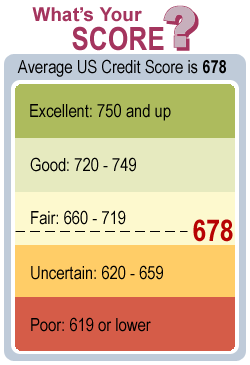
It is nothing new, that a report of your credit is ordered when applying for a loan.  But in recent years, your credit standings are used to determine so much more, like how much you will pay for auto and home owners insurance.  Your credit can also be used by potential employers as a criterion for offering you a job.  That 3 digit number wields a great deal of power these days.  So just how is that number determined?  Maybe more important is how can you control it?

The next few posts will touch of some of these questions to help you understand, what a credit score is, how it is determined, how to build a good credit score, and how to repair a low score.

 What goes into a credit score?

Your credit score will include four types of information: public record, credit, credit inquiries and personal.  Information of public record are pieces reported by the judicial system.  It may include judgments, foreclosures, bankruptcies, tax liens, or overdue child support.  Depending on what type of information is disclosed on your report, the data could stay there for 7-15 years.

Credit information is data relating to specific accounts you have or have had in the past.  For each account the date opened, credit limit (or original loan amount), balance, payment amount and payment history will be listed.  Your report will also detail those accounts you are a co-borrower on.  Negative information can remain for up to 7 years from the date it was last reported.  Fortunately positive information can remain indefinitely.

Requests by other creditors to review your credit history will also be listed on your report along with the date requested.  This information is visible to anyone else who may request your credit.  Information for the purpose of extending pre-approved credit offers are only revealed to you and do not impact your overall credit score. 

Personal information includes your name, address, phone number, social security number, date of birth, employer and sometimes your job title.  The report will include both current and past information.

Knowing this, it is easy to see why your credit report is so important to understand and monitor


0 Comments

DIY or Hire a professional to repair credit

6/28/2014

0 Comments

 
Picture
When credit repair was relatively new, it was easy to improve your credit score. The Fair Credit Reporting Act (FCRA) was created to ensure and enforce your right to fair and accurate credit reporting. It gave you the right to dispute credit and often times it worked.

That was then, this is now and these letters are a waste of time, so are the credit repair companies that use them.

One of its provisions states that a consumer may request in writing validation, or proof of any debt with the Credit Reporting Agencies (CRA's). They then have 30 days to prove the debts accuracy. If they cannot provide the necessary proof in the given time frame, the debt has to be deleted from your credit report. Sounds easy right?

As you can imagine 30 days is not a long time to gather the necessary documents when you consider CRA's are responsible for millions of account files.

It didn't take long for opportunists masquerading as credit repair agencies to surface capitalizing on this loophole. For a while it worked and the concept was simple yet affective. A full frontal attack on the credit bureaus and the strategy was an overwhelming amount of dispute letters, so many that the credit bureaus had no chance of responding in time. As a result, millions of trade lines were deleted. They still are today, just not nearly as effectively as they once were.

This abuse of the system forced CRA's to create systems that allowed them quickly verify debts. They did, and can now verify debts in a matter of minutes. Can you blame them? Not only is this method outdated and ineffective, it makes your situation worse.

Once a debt has been verified, any further attempts of the same debt become near impossible and that applies to legitimate inaccuracies. Had it been disputed properly, and for valid reason, there's a great chance it would have come off legally and permanently the first time.

If you believe anything, believe us when we say these dispute letters are that last method in which you want to repair your credit. It doesn't take a whole lot of common sense to realize Credit Bureaus, collection agents or the original creditors are not going to let millions of people dodge debts over a relatively minor detail like this.

The key to successful credit repair whether it is on your own, or choosing a legitimate company to do it for you, is research. Nearly every single credit report we see, has some form of violation of your rights committed by collection agents.

Learn the FCRA & The FDCPA and you will find the violations. Find them and the debts will come off legally and permanently.

Why Credit Repair Mills Stink:
When credit repair was new, it was easy. You wrote a letter to the credit agencies "disputing" items you wanted removed. They had 30 days to verify the debts and if they couldn't do it in time, the item had to be removed. Sounds easy don't it?


So what's wrong with this method today? As you can imagine that cost creditors millions. As a result, they created systems to quickly verify debts and once they do, further disputes are considered frivolous and returned un-investigated. Can you blame them?

I'm sure we can agree that common sense dictates the following; if all that is required of credit bureaus is to respond to these letters in 30 days, you can bet they will. With the exception of a few that slip through the cracks, (the hope of other credit repair companies) your letters will be answered and your job harder.

To error is human - To capitalize on error is smart! As we discussed previously, credit bureaus validation system is completely automated. What's not automated is the method in which your credit history is input into the system. It is put in by hand, by humans and we all know the phrase "human error." This is the best kept secret of credit repair. If something is erroneous, it will come off permanently and you could even be awarded damages.

Think about it. What makes more sense, trickery, luck and relying on loopholes, or violations of your rights where the law is there to protect you?

It's easy to spot a company that depends on these credit repair letters. Look at their sign up process. If it instructs you to send them your credit reports, tell them which items to dispute and that they do the rest, save your money and do it yourself.

Think about it, if they know nothing about your alleged debts, what more could they possibly do then send the old generic "this is not my debt, please delete it" letter? You might as well just send that worthless letter yourself and save yourself the money.

The Bottom Line... Credit repair works and as long as consumers have the legal right to question items on their credit, it always will. What doesn't work is the tired methods these so called credit experts are charging you for. There is no secret and no magic letter.

To effectively repair your credit, you need to arm yourself with information and you need a lot of patience...

If you decide to go with a professional make sure you check out Lexington Law, rated number 1 in the nation on credit repair. 
Legal, effective credit report repair
0 Comments

A Bad Credit Score Will Cost You

6/27/2014

0 Comments

 
Like it or not, credit is a necessity. From the house that you live in, to the car that you drive, your credit score impacts almost every facet of your life. With today’s economic challenges, it has become more important than ever to achieve and maintain a healthy credit score.

For those with bad credit, increased interest rates may further inflate the cost of living, making even trivial purchases seem difficult. A bad credit score can cost you hundreds each month in interest payments, or can keep you from getting approved for credit altogether. Use the infographic below to see how much money having a bad credit score could cost you.


Picture
A bad credit score could cost up to:
  • $243,720 for a $150,000 mortgage
  • $325,440 for a $200,000 mortgage
  • $406,440 for a $250,000 mortgage
*Interest rates are approximate based on rates as of 9/12/2011. Rates offered may vary based on your credit score, the financial lender, where you live and current financial markets.

Numbers like this make it easy to see the financial burden created by bad credit, but the real cost is more difficult to measure. bad credit affects more than your finances, it can also attack your sense of security, and limit your personal freedom.

Fortunately, the cost of working with Lexington Law to take action on your credit is much easier to quantify. Our services start at an affordable $59.95 a month.

For about the same price of a monthly cable bill how can you afford not to take action on your credit?


0 Comments

    Archives

    January 2023
    December 2018
    September 2018
    August 2018
    July 2018
    April 2018
    March 2018
    September 2017
    August 2017
    January 2017
    December 2016
    November 2016
    November 2014
    July 2014
    June 2014
    January 2014
    October 2013
    August 2013
    April 2012

    Categories

    All
    A Credit Card
    A Credit Card
    #badcredit
    #badcredit
    Bad Credit
    Bad Credit
    Card Credit
    Card Credit
    College Student
    College Student
    College Student Credit Card
    College Student Credit Card
    Credit
    Credit Card
    Credit Card
    Find Me A Credit Card
    Find Me A Credit Card
    For Which Credit Card
    For Which Credit Card
    Help Me Find A Credit Card
    Help Me Find A Credit Card
    How Can I Get A Credit Card
    How Can I Get A Credit Card
    How Do I Get A Credit Card
    How Do I Get A Credit Card
    How Do You Get A Credit Card
    How Do You Get A Credit Card
    What Is A Credit Card
    What Is A Credit Card

    RSS Feed

Powered by Create your own unique website with customizable templates.
Photo used under Creative Commons from Got Credit